6 Noterro Alternatives for Different Practice Workflows in 2026
08.09.26
This guide compares six practice management platforms based on real clinic workflows, practitioner needs, pricing, and where each tool actually performs better.
Most often, choosing a Noterro alternative is rarely about finding software with a longer feature list. It is usually about fixing the parts of your workflow that become frustrating once you are actually using the platform every day.
For some practices, that means reporting that does not go deep enough. For others, it is booking limitations, staff management, billing workflows, or simply too many small workarounds adding friction to an already busy clinic. None of these problems necessarily make Noterro a bad platform. But they can make it the wrong one for your practice.
Therefore, in this guide, we will try to answer some key questions:
Where Noterro may be holding your practice back
Which alternatives are actually worth considering
When switching would create more problems than it solves
There is no single “best” alternative to Noterro because the right choice depends on what your practice needs to do better. Some platforms are stronger for insurance-heavy chiropractic clinics, others for massage businesses, multidisciplinary teams, or practices that simply want fewer pricing surprises.
The table below is the shortlist I would start with based on those different priorities.
If your priority is…
I’d shortlist…
Why
Faster chiropractic workflow
Ruana
Cheapest per-practitioner scaling, memberships included from entry, no tier-hunting
Multidisciplinary clinic
Jane App
Room and equipment management, concurrent scheduling, deepest charting
Flat band pricing, every feature on every plan, unlimited admin users
Mental health + insurance
SimplePractice
Native telehealth on all plans, claims filing built in
Chiropractic insurance/EHR
ChiroTouch
Chiropractic-specific claims, coding, and EHR depth
Before You Switch: What Noterro Already Does Well
Any honest comparison has to start here, because Noterro’s strengths are the reason so many practices still choose it.
Price for What You Get
This is the single most common reason people use it, and the comparison is almost always Jane App.
“It is much more affordable than Jane App” (Lauren S., Registered Psychologist, April 2025).
“Has all the features you need at a lower price than the competition” (Karen P., Athletic Therapist, October 2024).
Support
Unusually well-reviewed.
“The customer service is hands down the best I’ve ever worked with” (Theresa B., Owner and Massage Therapist, August 2025).
Ease of Use
“Ease of use, super easy to make availability for doctors” (Cameron S., Chiropractor, June 2025).
Shipping Speed
The team updates frequently, and reviewers notice.
Where Practitioners May Start Looking Elsewhere
Six patterns come up often enough to be structural rather than anecdotal.
Scheduling Granularity
The most detailed critical review I found is from a multi-practitioner physiotherapy owner listing, among other things, an “inability to book with 5-minute clean-up time” and an “inability to push automated waitlist notifications” (Sasha G., Physiotherapist and Owner, September 2025).
Noterro also has no room or resource booking, and its double-booking mode is internal only, since clients cannot book overlapping slots online.
Solo-Practitioner Pricing After the August 2025 Change
“The new pricing model is not sole-practitioner friendly” (Anna R., Physical Therapist, June 2025).
“Every feature costs extra” (Brent M., Co-owner).
No Native Telehealth
This is a genuine deal-breaker for mental health buyers.
“I didn’t like that it didn’t have an integrated video platform” (Lauren S., April 2025).
“No video platform, more geared towards doctors” (Regina D., Psychotherapist, October 2024).
Noterro’s own help documentation confirms the approach: you paste a Zoom or Google Meet link into a notification template.
Charting Layout
“Clinical notes would’ve been easier to read if multiple notes from different dates show on the same screen like Cliniko does” (Chika S., Massage Therapist, May 2025).
Others cannot view charts and the calendar simultaneously.
Forward-Looking Reporting
“There’s no future analytic reports. I would love to know how I’m doing so far” (Madison P., Massage Therapist, July 2025).
Payment Processing
Noterro does not process payments itself. It integrates with Square or Bambora, which means a second account and a second reconciliation.
How We Evaluated the Alternatives
I ran each product against the same eight-step clinic day, because that is where software either helps or gets in the way:
New patient books → completes intake → checks in → practitioner documents the visit → front desk checks them out → invoice and payment → follow-up and rebooking → owner reviews performance
Every seam between those steps is a manual handoff. A product that saves you four minutes on charting but adds two logins at checkout has not improved anything. That test is what the recommendations below are based on, rather than feature counts.
6 Noterro Alternatives Worth Considering
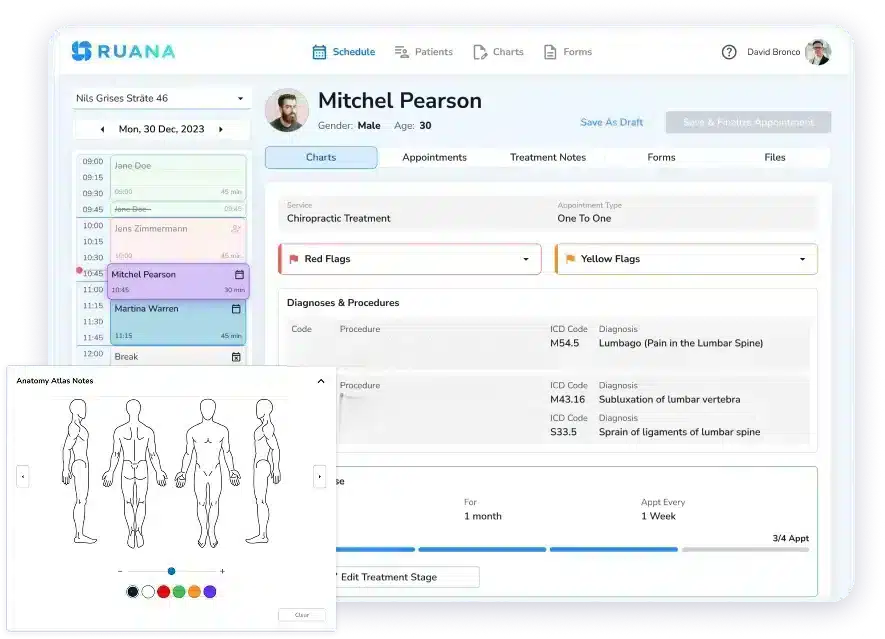
Ruana
Best for: Solo and small chiropractic, massage, and mental health practices that want fewer tiers and cheaper growth.
Why I’d choose it instead of Noterro. The clearest reason is per-practitioner cost. Ruana charges $19.99 for each additional practitioner, compared to Noterro’s $22 to $27.50 on the tiers where most clinics actually sit, and the entry plan is $35.99 with no appointment cap.
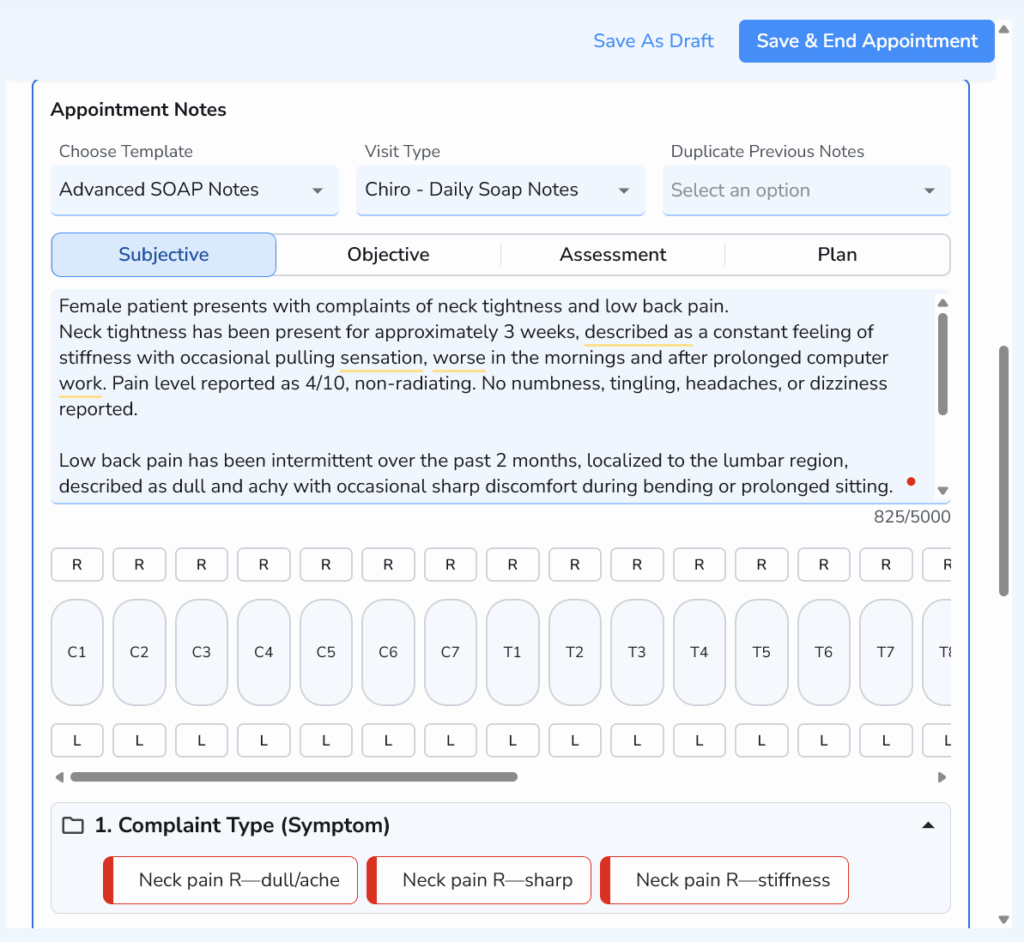
The second reason is tier gating, which is the specific thing solo practitioners complain about in Noterro reviews. Packages and memberships sit on Ruana’s Professional plan at $55.99, not on a top tier at $77. Intake forms and SOAP notes are included from Solo.
Third is the trial. Fourteen days, full access, no credit card, which removes the “I spent my trial on the wrong tier” problem that shows up in Noterro reviews.
What I’d miss from Noterro. Direct insurance claim submission, including TELUS eClaims and CMS-1500, since Ruana does superbills only.
✨My verdict. Choose Ruana if you are cash-pay or superbill-based, and the per-seat maths or the tier gating is what bothers you.
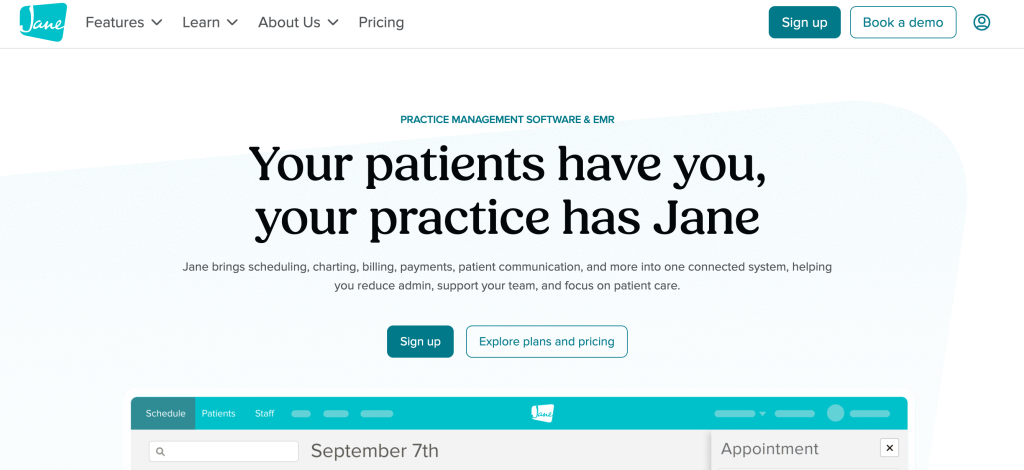
Jane App
Best for: Multidisciplinary clinics with several practitioners, rooms, and overlapping schedules.
Why I’d choose it instead of Noterro. Jane App solves the exact scheduling complaints in Sasha G.’s review. It has room and equipment management, handles concurrent appointments properly, and supports availability tags and add-on treatments. For a clinic running three practitioners across two treatment rooms with different equipment, that is the difference between a calendar that works and a daily workaround.
Charting is deeper, telehealth is native on every plan rather than a pasted link, and insurance billing runs through an integrated Claim.MD connection.
What I’d miss from Noterro. The price, mainly. Jane App starts at $54 with a 20-appointment monthly cap, the realistic plan is $79, and additional practitioners cost $39 part-time or $49 full-time. There is no free trial at all. Insurance billing, AI scribe, and group telehealth are paid add-ons on top.
My verdict. Choose Jane App if room-based or concurrent scheduling is the constraint. Stay with Noterro if you are one or two practitioners in one room, because you would be paying for coordination you do not need.
ClinicSense
Best for: Massage practices whose actual problem is filling the calendar, not documenting it.
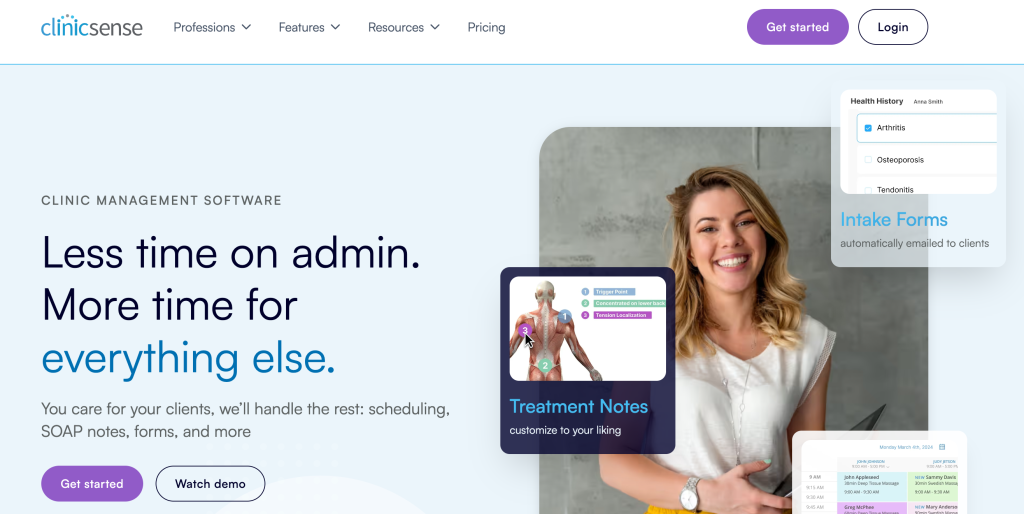
Why I’d choose it instead of Noterro. ClinicSense treats marketing as core rather than an integration. Email newsletters, birthday and wellness check-in campaigns, referral automation, and Google review requests are built in, alongside No-Show Guard, which takes a deposit or holds a card at booking.
That last piece addresses something Noterro handles less directly. If late cancellations are costing you two or three sessions a week, prepayment at booking is worth more than any charting improvement.
What I’d miss from Noterro. Appointment caps, which are a real ceiling: 20 per month on Lite and 200 on Standard, with unlimited only at $99. No telehealth of any kind. Insurance support is TELUS eClaims for Canada only, with no US claims path. Payments route through Square rather than natively.
My verdict. Choose ClinicSense if retention and rebooking are your bottleneck and you are comfortably inside the appointment caps. Stay with Noterro if you need US insurance workflows or your volume exceeds 200 visits a month.
Cliniko
Best for: Growing teams that want one price and no feature tiers.
Why I’d choose it instead of Noterro. Cliniko prices in bands by practitioner count rather than per seat, and every plan includes every feature. One practitioner is $45 a month. Two to five practitioners is $95 total. Six to eight practitioners is $145. Admin and reception users are unlimited and free at every level.
Run the comparison at four practitioners. Cliniko is $95 flat. Noterro Plus is $55 plus three seats at $22 each, which is $121, and you still do not have packages or memberships until you reach Max. The tier-hunting that frustrates Noterro’s solo users disappears entirely here.
Telehealth is native, the trial is 30 days with no credit card, and migration is free.
What I’d miss from Noterro. No packages or memberships at all, which is a genuine gap for wellness practices selling visit blocks. Reporting is widely described as thin. SMS is metered at 10 cents per message rather than 500 included. Insurance claiming is strong in Australia through Tyro and HealthPoint, third-party in New Zealand, and essentially absent in North America.
My verdict. Choose Cliniko if you are growing past three practitioners and want predictable pricing. Stay with Noterro if you sell packages or memberships, or if you bill Canadian or US insurance.
SimplePractice
Best for: Mental health practices billing insurance in the US.
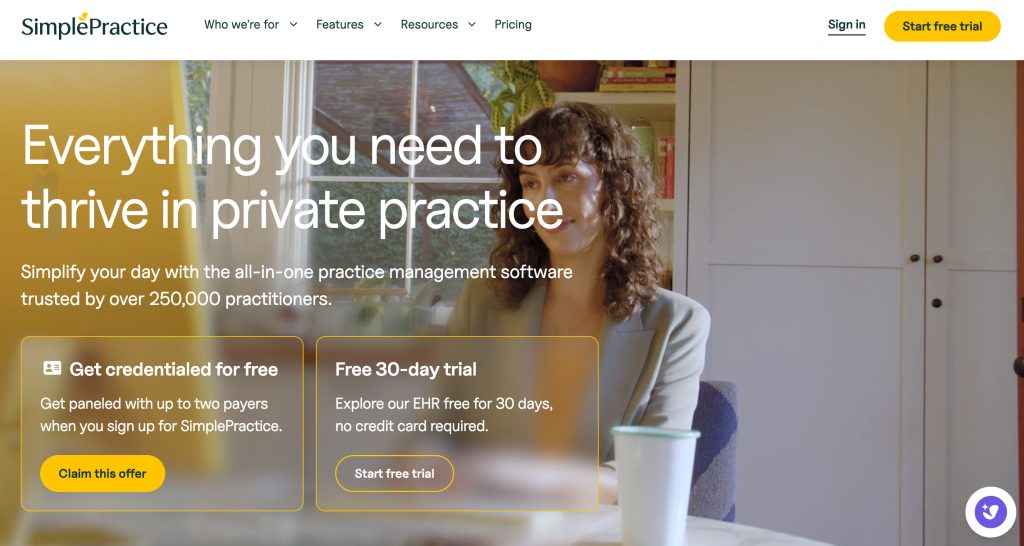
Why I’d choose it instead of Noterro. This one is straightforward because it fixes the complaint that Noterro’s mental health reviewers name explicitly. Telehealth is native and included on every plan, including the $49 Starter tier.
Claims filing is built in rather than integrated, with 10 free claims a month on Essential and 35 on Plus before per-claim fees. The trial is 30 days, the longest here, and there is a Therapy Finder directory listing that brings in referrals.
What I’d miss from Noterro. Price and simplicity. Starter is heavily restricted, with reminders working only for telehealth appointments and no reporting, secure messaging, or calendar sync. Group practices pay $74 per additional clinician, which is roughly three times Noterro’s rate. Add-ons stack quickly.
My verdict. Choose SimplePractice if you are a therapist who needs telehealth and electronic claims in one place. Stay with Noterro if you are hands-on treatment-focused, because you would be paying for a mental health product.
ChiroTouch
Best for: Established chiropractic clinics with serious insurance volume.
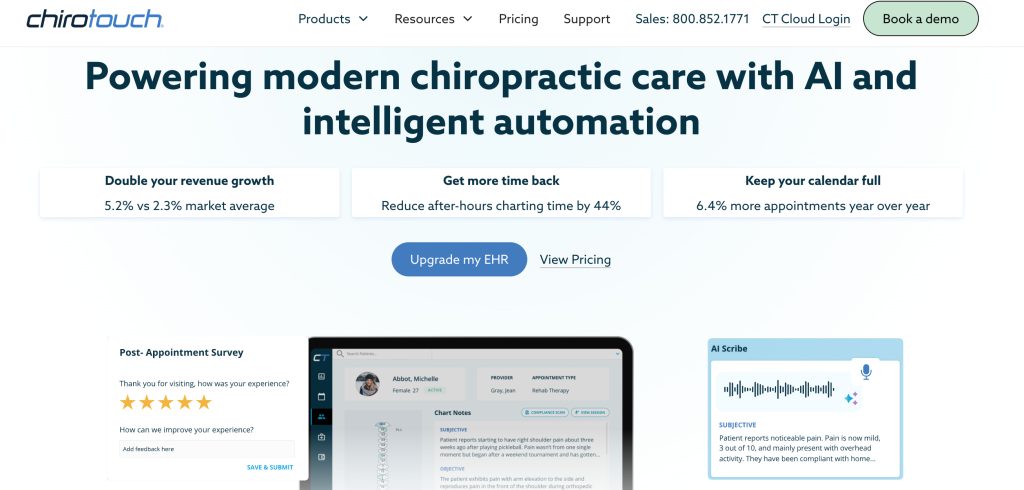
Why I’d choose it instead of Noterro. Depth in one discipline. ChiroTouch has chiropractic-specific EHR and charting, its own clearinghouses, eligibility verification, ERA auto-posting, automatic patient recall, and two-way texting. Its Core product is positioned specifically at cash-based chiropractors, with care plans and recurring payments included.
For a high-volume practice with a dedicated biller, that specialisation is worth real money in a way that a general allied health product cannot match.
What I’d miss from Noterro. Almost everything about the buying experience. ChiroTouch publishes no pricing and no free trial, so evaluation starts with a sales call. Third-party sources report entry pricing around $139 a month. Reviewers consistently mention add-on fees, difficult onboarding, and slow performance. It is also chiropractic-only.
My verdict. Choose ChiroTouch if chiropractic insurance billing is central to how you operate and you have someone to run it. Stay with Noterro if you value transparent pricing and a system you can trial yourself.
What I’d Choose in 5 Real Practice Scenarios
Feature tables rarely settle a purchase. These are the situations practitioners actually describe, with the answer I would give.
I’m a Solo Massage Therapist Seeing 20 to 30 Clients a Week
Stay with Noterro, most likely. At $33 on Core, you are well served, and your volume sits comfortably inside anyone’s limits. If SMS reminders matter, compare Noterro Plus at $55 against Ruana Professional at $55.99, which includes memberships that Noterro reserves for Max. If your real problem is empty slots rather than admin, look at ClinicSense for the marketing automation.
I’m Running a Three-Practitioner Cash-Pay Chiropractic Clinic
Ruana or Cliniko. Noterro Plus at three practitioners is $99. Ruana Professional is $95.97 with memberships included. Cliniko is $95 flat with every feature and room to add two more practitioners at no extra cost. Cash-pay means the insurance gaps in both are irrelevant. I would trial Ruana for the workflow.
I’m Building a Multidisciplinary Clinic with 5+ Practitioners
Jane App, and this is the clearest call in the article. Once you have multiple disciplines sharing rooms and equipment, the room management and concurrent scheduling stop being conveniences. Cliniko is the value alternative at $95 for two to five practitioners, but it has no documented room booking, so check that against your layout before committing.
Most of My Chiropractic Revenue Comes Through Insurance
ChiroTouch, or Noterro Max. Noterro Max at $77 includes CMS-1500 auto-fill and works with Availity, Office Ally, and Trizetto, which is enough for many practices and far cheaper than the alternative. Move to ChiroTouch when claims volume justifies dedicated chiropractic billing infrastructure and you have staff to operate it.
I’m a Therapist Who Needs Telehealth and Electronic Claims
SimplePractice. Noterro has no native telehealth, which its own mental health reviewers flag repeatedly, and a pasted Zoom link is not a clinical telehealth workflow. This is the one scenario where leaving Noterro is close to automatic.
The Short Version
Noterro is good software at a fair price, and its review record says so. The reasons to leave are specific rather than general: room-based scheduling, native telehealth, packages you do not want gated behind a top tier, flat team pricing, or cheaper growth per practitioner.
Name which of those describes your clinic before you start trialling anything. If none of them do, the best move is usually to stay, and to spend the switching effort on something that actually changes your week.
If cheaper per-practitioner scaling and fewer tiers is the gap, Ruana is worth 14 days of your time. Full access, no credit card, and most clinics are running in 30 to 90 minutes.
Pricing and review data verified in September 2026. Plans change, so confirm before purchasing.
About the Authors
★★★★★4.9 · 329 Reviews
Rouzbeh NoroozyChiropractor & Co-Founder · Palmer West · UC Berkeley · 14 Years of ExperienceRouzbeh Noroozy is a chiropractor with 14 years of clinical experience and co-founder of Ruana practice management software. He completed his undergraduate studies at the University of California, Berkeley and graduated from the renowned Palmer College of Chiropractic West in California. As a practicing clinician and clinic owner, he understands firsthand the administrative challenges practices face — and which digital tools genuinely help streamline day-to-day operations.
Anastasiia NoroozyMedical Graduate & Co-Founder · 8 Years of ExperienceAnastasiia Noroozy is a medical graduate and co-founder of Ruana with 8 years of experience working directly with patients at the clinic in Cologne. She manages the day-to-day flow of the practice and knows every patient-facing process from the inside out — from intake and scheduling to follow-up care. Her hands-on clinical and operational experience directly shapes how Ruana is built to work in the real world.
Our team will review your inquiry and get back to you as soon as possible.
Privacy Settings
To provide the best experiences, we use technologies like cookies to store and/or access device information. Consenting to these technologies will allow us to process data such as browsing behavior or unique IDs on this site. Not consenting or withdrawing consent, may adversely affect certain features and functions.
Functional
Always active
The technical storage or access is strictly necessary for the legitimate purpose of enabling the use of a specific service explicitly requested by the subscriber or user, or for the sole purpose of carrying out the transmission of a communication over an electronic communications network.
Preferences
The technical storage or access is necessary for the legitimate purpose of storing preferences that are not requested by the subscriber or user.
Analytics
The technical storage or access that is used exclusively for statistical purposes.The technical storage or access that is used exclusively for anonymous statistical purposes. Without a subpoena, voluntary compliance on the part of your Internet Service Provider, or additional records from a third party, information stored or retrieved for this purpose alone cannot usually be used to identify you.
Marketing
The technical storage or access is required to create user profiles to send advertising, or to track the user on a website or across several websites for similar marketing purposes.
To provide the best experience for our practitioners, we use cookies to personalize content, analyze our traffic, and support our marketing efforts. By clicking 'Accept', you consent to our use of these technologies. You can manage your preferences at any time.
Functional
Always active
The technical storage or access is strictly necessary for the legitimate purpose of enabling the use of a specific service explicitly requested by the subscriber or user, or for the sole purpose of carrying out the transmission of a communication over an electronic communications network.
Preferences
The technical storage or access is necessary for the legitimate purpose of storing preferences that are not requested by the subscriber or user.
Analytics
The technical storage or access that is used exclusively for statistical purposes.The technical storage or access that is used exclusively for anonymous statistical purposes. Without a subpoena, voluntary compliance on the part of your Internet Service Provider, or additional records from a third party, information stored or retrieved for this purpose alone cannot usually be used to identify you.
Marketing
The technical storage or access is required to create user profiles to send advertising, or to track the user on a website or across several websites for similar marketing purposes.