Wellness Marketing: 9 Strategies to Attract and Retain More Clients
10.09.26
Learn essential marketing strategies that help chiropractors, massage therapists, and mental health professionals build thriving practices through smart digital marketing and efficient systems.
Here is the thing most wellness practices get wrong about marketing: getting more clients is rarely about doing more marketing. In fact, it is about knowing where your practice is losing them.
Somebody searched for what you do and never found you.
Another person landed on your site, read three paragraphs, and closed the tab.
A third booked once and never came back.
Each is a different problem with a different fix, and pouring budget into Instagram solves only one of them.
So instead of a list of channels, this guide follows the path a client actually takes:
Health and wellness marketing is how a practice becomes visible to the people who need it, earns enough trust for them to book, and stays present enough that they return and refer.
It covers your website, local search presence, content, reviews, social media, email, referral relationships, and paid advertising. It also covers what most practices never file under “marketing”: how easy you are to book, what your confirmation email says, whether intake arrives before the visit, and whether anyone follows up.
That second group matters more than it gets credit for, because in a small practice marketing and client experience are the same thing viewed at different moments.
Start With Your Positioning Before Choosing Marketing Channels
Before spending an hour or a pound on any channel, get clear on three things. Positioning makes every downstream decision easier, and skipping it is why so much wellness advertising underperforms.
Define Who Your Practice Is Really For
“Anyone who needs bodywork” is not an audience. It is the absence of one, and it produces marketing that sounds like everyone else’s.
Look at your actual books. “Who fills the calendar, who gets the best results, who do you genuinely enjoy treating?” Patterns emerge fast: desk workers with neck tension, runners with recurring injuries, new mothers, people managing chronic pain.
Naming that group turns nobody away. It gives the right people a reason to recognise themselves and stop scrolling. A practice known for something specific gets recommended by name, while a practice known for everything gets recommended vaguely, if at all.
Identify the Problem That Brings Them to You
Nobody books a wellness appointment because they want one. They book because something became intolerable.
Headaches that start every afternoon at three.
A shoulder that will no longer lift a toddler.
Clients describe these in plain, frustrated, physical language, and your marketing should use that language back to them.
The mismatch is common: practitioners write about modalities, techniques, and credentials, while clients search for symptoms. Whichever side of that gap your website sits on decides whether you get found.
Give Prospective Clients a Reason to Choose Your Practice
Once someone finds three practices offering the same service at similar prices, something has to break the tie.
It might be genuine specialisation, evening availability, a particular approach, treatment length, a calmer room, or simply being the only practice they can book at nine at night without calling. Whatever it is, say it plainly and put it where people see it first.
👉If you cannot name your differentiator in one sentence, prospective clients cannot either, and they default to whoever appears first in the map results.
9 Wellness Practice Marketing Strategies That Actually Support Growth
One warning before the list: do not attempt all strategies at once.
Practices launching a blog, a social calendar, an email programme, and an ads account in the same month usually abandon all four by spring. Pick two or three that match where your funnel leaks, run them properly for a quarter, then add more.
1. Build a Website Designed to Turn Visitors Into Appointments
Most wellness websites are brochures, while the good ones are conversion tools.
A brochure describes your philosophy, your training, and your treatment room. But you need a conversion tool that answers the visitor’s question, addresses their hesitation, and gives them an obvious way to book within seconds of landing.
What that looks like:
A clear headline stating what you do and who you help, above the fold
A booking button visible on every page, not buried in the contact form
Individual service pages rather than one page listing eight treatments in a sentence each
Answers to the questions that stop people booking: what the first visit involves, how long it takes, what it costs, whether it hurts
Real photos of your space and practitioners, not stock images of candles
Fast loading on mobile, since most wellness searches happen on a phone
Test it yourself. Open the site on your phone and time the journey from landing to booked. If that takes more than a minute, it means you have found your first task.
2. Build Local Search Visibility
For most wellness practices, marketing is fundamentally local, and Google is fairly transparent about how local results work.
The following three factors decide them:
Relevance. How well your practice matches what someone searched. Google recommends providing complete and detailed business information so it can make that match, which means your categories, services, hours, description, and website all need to be filled in properly.
Distance. How far you are from the searcher. This is the factor you cannot influence, so stop trying. Building twelve near-identical pages for neighbouring towns does not move your clinic.
Prominence. How well established your practice appears, influenced by information across the web including links and reviews. Google states directly that more reviews and positive ratings can improve local ranking.
✨The takeaway is clean: you cannot change distance, so pour everything into relevance and prominence. Claim and complete your Google Business Profile, keep your name, address, and phone number identical everywhere they appear, add real photos, and build reviews consistently.
3. Create Content Around Questions Clients Ask Before Booking
“Just start a blog” is bad advice. “Answer the eleven questions people ask before booking” is excellent advice, and a far smaller job. You already have the list that includes topics like:
Intake conversations and consultations
Emails and enquiry forms
Phone calls your front desk fields daily
Google Search Console, showing what people searched before landing on you
Reviews, where clients describe what mattered to them
Your practitioners, who answer the same three questions every week
Also, the following categories cover almost everything worth writing:
Category
Example
First-visit explainers
What happens at a first chiropractic appointment
Condition guides
What causes tension headaches from desk work
Safety and suitability
Is massage safe during pregnancy
Comparisons
Chiropractor or physiotherapist, which do I need
Write four properly rather than twenty in a hurry, and link every one to its related service page. Content that leads nowhere generates traffic and no appointments.
4. Make Reviews Part of Your Marketing System
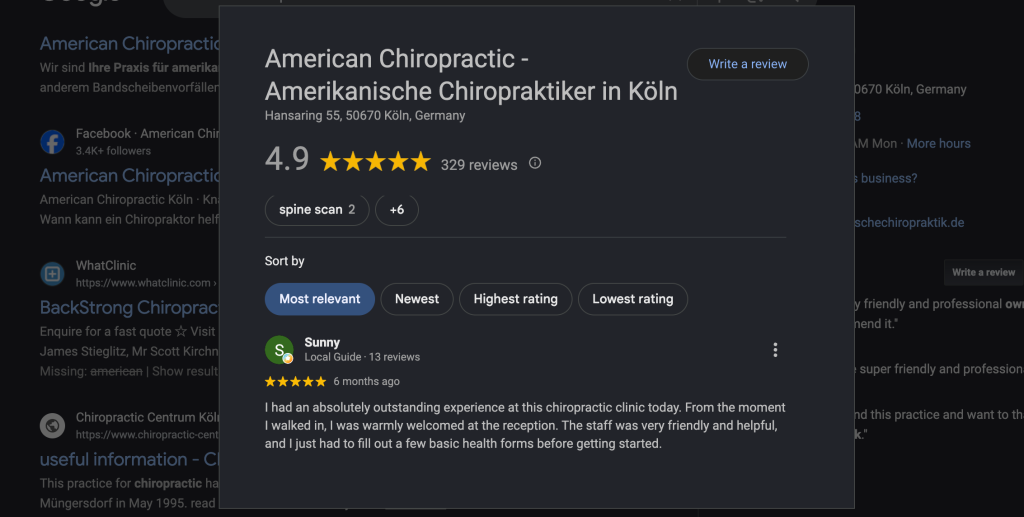
Reviews do two jobs at once. They feed the prominence factor in local ranking and close the decision for someone comparing you against two competitors.
Practices with hundreds of reviews rarely provide better care. They just have a habit of asking:
In person at the end of a good session while the client is still saying nice things
Followed by a direct link or a QR code at reception
With one person owning the task and replying to every review, including the difficult ones.
💡Remember these two rules: Google permits asking and sharing a link but prohibits incentives in exchange for reviews. Public responses must never confirm someone is a client or reference anything clinical.
5. Use Social Media to Build Familiarity, Not Just Reach
Forget follower counts. For a local practice, social has one job: letting prospective clients see how you think, what the practice feels like, and whether they would trust you with their body. That reframe changes what you post.
Based on our own clinical experience, these four formats do the work:
Educational posts explaining common conditions in plain language
Practical tips delivering value immediately, like a stretch for desk-related neck tension
Behind-the-scenes content showing your space, approach, and personality
Client success patterns, kept anonymous, helping someone picture their own improvement
Post about what your ideal clients already worry about. For instance, a prenatal massage specialist should cover pregnancy discomfort, safe stretching, and when bodywork helps, because those are the searches happening at eleven at night.
6. Build Referral Partnerships Around Complementary Services
The most underrated channel in wellness marketing, and it costs nothing but a coffee.
Your ideal clients already see other professionals: physiotherapists, personal trainers, yoga and Pilates studios, running clubs, nutritionists, GPs, podiatrists. Many of them regularly meet people they cannot fully help and have nobody specific to send them to.
Make it easy to be that person. Introduce yourself properly, be clear about who you are the right fit for, and refer generously in return. A relationship where traffic flows both ways survives. Sponsorships work the same way. For instance, local clubs and charity events usually have partner pages happy to link back to you, which quietly helps local ranking too.
7. Use Paid Wellness Ads Only After the Conversion Path Works
Paid advertising is an amplifier, not a fix. Point it at a website that does not convert, and you will pay to watch people bounce faster.
Get four things working first:
A site that turns visitors into bookings
A solid base of reviews
Online booking that works on a phone
A complete Google Business Profile
Once that path holds, wellness ads become genuinely useful.
Then keep it tight. Local search ads on high-intent terms like “massage therapist near me” beat broad awareness campaigns for a single-location practice. Small budget, traffic pointed at a specific service page rather than the homepage, and success measured in bookings rather than clicks.
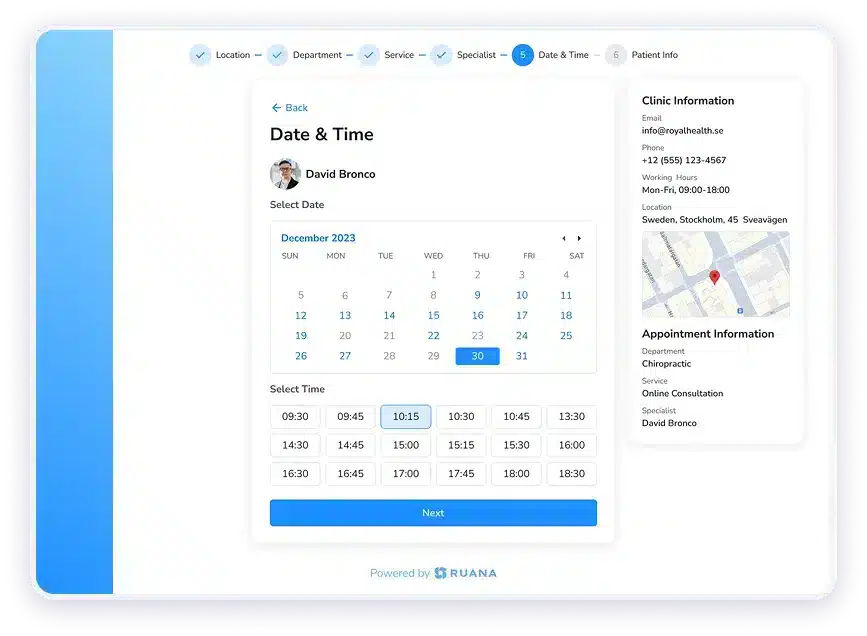
8. Turn the Booking Experience Into Part of Your Marketing
Every marketing pound you spend delivers someone to this journey:
Yet, every step is a chance to lose them. Someone who searched at nine in the evening, found you, decided you looked right, and then hit a phone number with opening hours starting at eight tomorrow morning is a client your marketing paid for and your booking process lost. Some will call. Plenty will go back to the results and book with whoever let them do it there and then.
As a result, smaller frictions stack up. A confirmation missing the address or parking details. Intake handed over on a clipboard while someone is in pain. No reminder, then a no-show nobody follows up. None feel like marketing problems, and all cost appointments your marketing already paid for.
Clients book 24/7 as guests, in under a minute, with no account or password required, while you keep control through daily appointment caps, working-hour limits, and protected time for documentation.
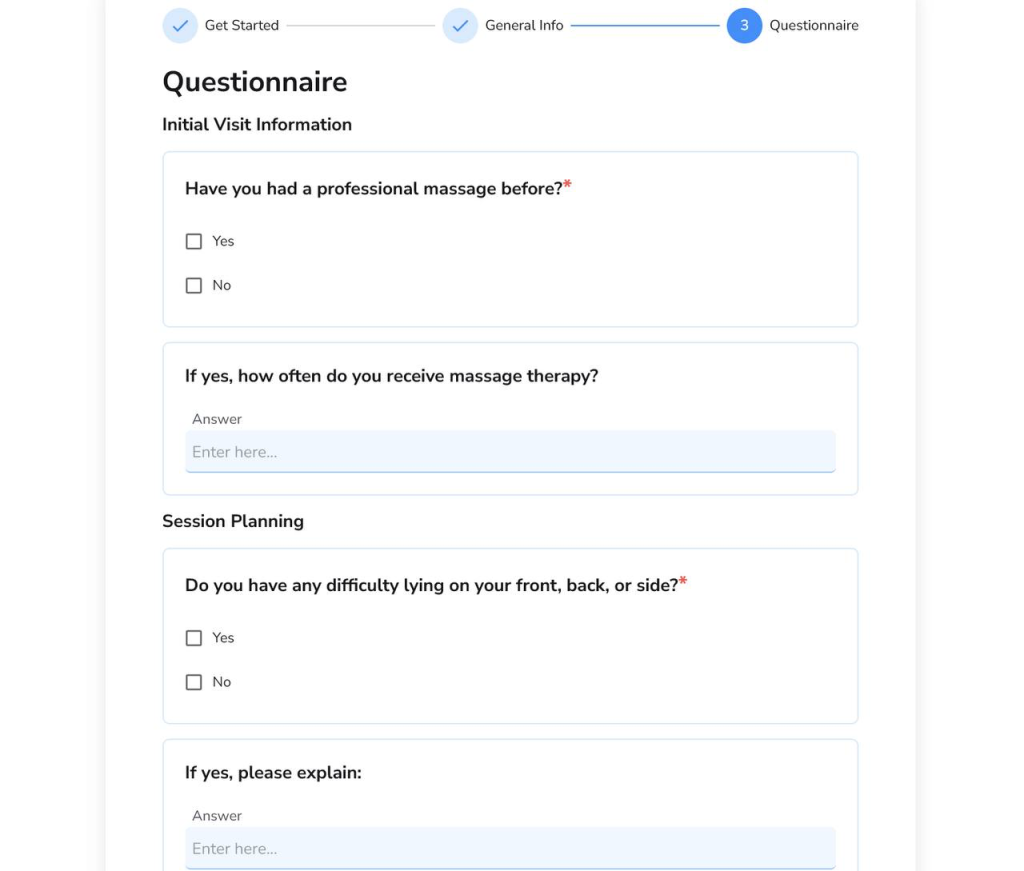
Intake forms go out automatically after booking and come back completed before the client arrives. Automated email confirmations and reminders keep the appointment, and clients can reschedule in one click from their confirmation email rather than phoning during your treatment hours.
The result is that the journey from search to appointment runs without a manual handoff at any point.
9. Build Retention and Referrals Into Your Growth Strategy
Acquiring a new client costs considerably more than keeping one, and wellness practices are unusually well placed to keep them, since the care is ongoing by nature.
Retention is not a single act but a compound of several correlated actions, like:
Rebook at checkout, while the client is in front of you and the benefit is fresh
Packages and memberships that make continuing the obvious choice rather than a fresh decision
Follow-up when a treatment plan ends, the moment most practices go quiet
Milestone and birthday messages, which take two minutes and get remembered
A referral ask right after someone tells you how much better they feel
Which Marketing Strategies Should Your Practice Prioritize?
Find your problem in the left column and start there. ⤵️
If your problem is…
Prioritise
First move this week
Nobody can find you
Local SEO + Google Business Profile
Claim and fully complete your profile, categories and services included
People visit but don’t book
Website + booking experience
Time the journey from landing to booked on your own phone
You’re getting low-quality enquiries
Positioning + service pages
Rewrite your homepage headline to name who you help
You’re too dependent on word of mouth
SEO + content + reviews
Publish one first-visit explainer and ask five clients for a review
You have many past clients but weak repeat bookings
Email + retention
Send one re-engagement email to everyone unseen in six months
You need results faster
Paid search + optimised landing pages
Point a small local search budget at one service page
Your local competition is strong
Reviews + local SEO + partnerships
Book coffee with two complementary practitioners nearby
You’re fully booked, but revenue is flat
Packages, memberships, rebooking
Add one package and offer it at checkout
You’re launching a new service
Service page + email + partnerships
Build the page first, then tell your existing list
Notice that almost none of these first moves involve posting more on social media. Visibility problems, conversion problems, and retention problems each have their own fix, and using the wrong one is how practices end up busy with marketing and quiet in the diary.
How to Measure Wellness Practice Marketing
Track these monthly and ignore vanity metrics entirely:
New client bookings by source, the only number reflecting revenue
Calls, direction requests, and booking clicks from your Google Business Profile
Website booking conversion rate: visitors who become appointments
Organic clicks by service page, showing which pages earn their place
Review count and average rating over time
Rebooking rate, or the share of clients booking a second appointment
Retention at 6 and 12 months, plus referral share of new clients
Cost per acquired client wherever you spend money
Google Search Console, your Google Business Profile performance reports, and your practice management software’s reporting cover nearly all of it for free.
💡One caution on patience: local SEO and content take three to six months to move, while booking and conversion fixes work immediately. Judge each channel on its own timeline rather than abandoning everything after a slow month.
Marketing Gets Clients Interested. Your Practice Experience Keeps Them.
The best wellness marketing is not the cleverest campaign. It is a practice that is easy to find, easy to trust, easy to book, and worth returning to.
Work in that order. Positioning first, so people recognise themselves in what you say. Then local discoverability, then trust through content and reviews, then removing every step between deciding and booking. Retention habits come last, turning one appointment into a relationship and a relationship into referrals.
You do not need all strategies running to grow. You need to know which link in your chain is weakest and fix that one properly before moving on.
When you reach the booking step, make sure the experience matches the marketing that earned it. Ruana brings online booking, scheduling, intake forms, reminders, charting, and reporting into one system for chiropractors, massage therapists, and wellness practitioners.
About the Authors
★★★★★4.9 · 329 Reviews
Rouzbeh NoroozyChiropractor & Co-Founder · Palmer West · UC Berkeley · 14 Years of ExperienceRouzbeh Noroozy is a chiropractor with 14 years of clinical experience and co-founder of Ruana practice management software. He completed his undergraduate studies at the University of California, Berkeley and graduated from the renowned Palmer College of Chiropractic West in California. As a practicing clinician and clinic owner, he understands firsthand the administrative challenges practices face — and which digital tools genuinely help streamline day-to-day operations.
Anastasiia NoroozyMedical Graduate & Co-Founder · 8 Years of ExperienceAnastasiia Noroozy is a medical graduate and co-founder of Ruana with 8 years of experience working directly with patients at the clinic in Cologne. She manages the day-to-day flow of the practice and knows every patient-facing process from the inside out — from intake and scheduling to follow-up care. Her hands-on clinical and operational experience directly shapes how Ruana is built to work in the real world.
Our team will review your inquiry and get back to you as soon as possible.
Privacy Settings
To provide the best experiences, we use technologies like cookies to store and/or access device information. Consenting to these technologies will allow us to process data such as browsing behavior or unique IDs on this site. Not consenting or withdrawing consent, may adversely affect certain features and functions.
Functional
Always active
The technical storage or access is strictly necessary for the legitimate purpose of enabling the use of a specific service explicitly requested by the subscriber or user, or for the sole purpose of carrying out the transmission of a communication over an electronic communications network.
Preferences
The technical storage or access is necessary for the legitimate purpose of storing preferences that are not requested by the subscriber or user.
Analytics
The technical storage or access that is used exclusively for statistical purposes.The technical storage or access that is used exclusively for anonymous statistical purposes. Without a subpoena, voluntary compliance on the part of your Internet Service Provider, or additional records from a third party, information stored or retrieved for this purpose alone cannot usually be used to identify you.
Marketing
The technical storage or access is required to create user profiles to send advertising, or to track the user on a website or across several websites for similar marketing purposes.
To provide the best experience for our practitioners, we use cookies to personalize content, analyze our traffic, and support our marketing efforts. By clicking 'Accept', you consent to our use of these technologies. You can manage your preferences at any time.
Functional
Always active
The technical storage or access is strictly necessary for the legitimate purpose of enabling the use of a specific service explicitly requested by the subscriber or user, or for the sole purpose of carrying out the transmission of a communication over an electronic communications network.
Preferences
The technical storage or access is necessary for the legitimate purpose of storing preferences that are not requested by the subscriber or user.
Analytics
The technical storage or access that is used exclusively for statistical purposes.The technical storage or access that is used exclusively for anonymous statistical purposes. Without a subpoena, voluntary compliance on the part of your Internet Service Provider, or additional records from a third party, information stored or retrieved for this purpose alone cannot usually be used to identify you.
Marketing
The technical storage or access is required to create user profiles to send advertising, or to track the user on a website or across several websites for similar marketing purposes.